Nils Frank · 25 September 2026
Eastern European Higher Education Institutions Integrate Digital Historical Records and Biotechnology Collaborations to Navigate Enrollment Shifts
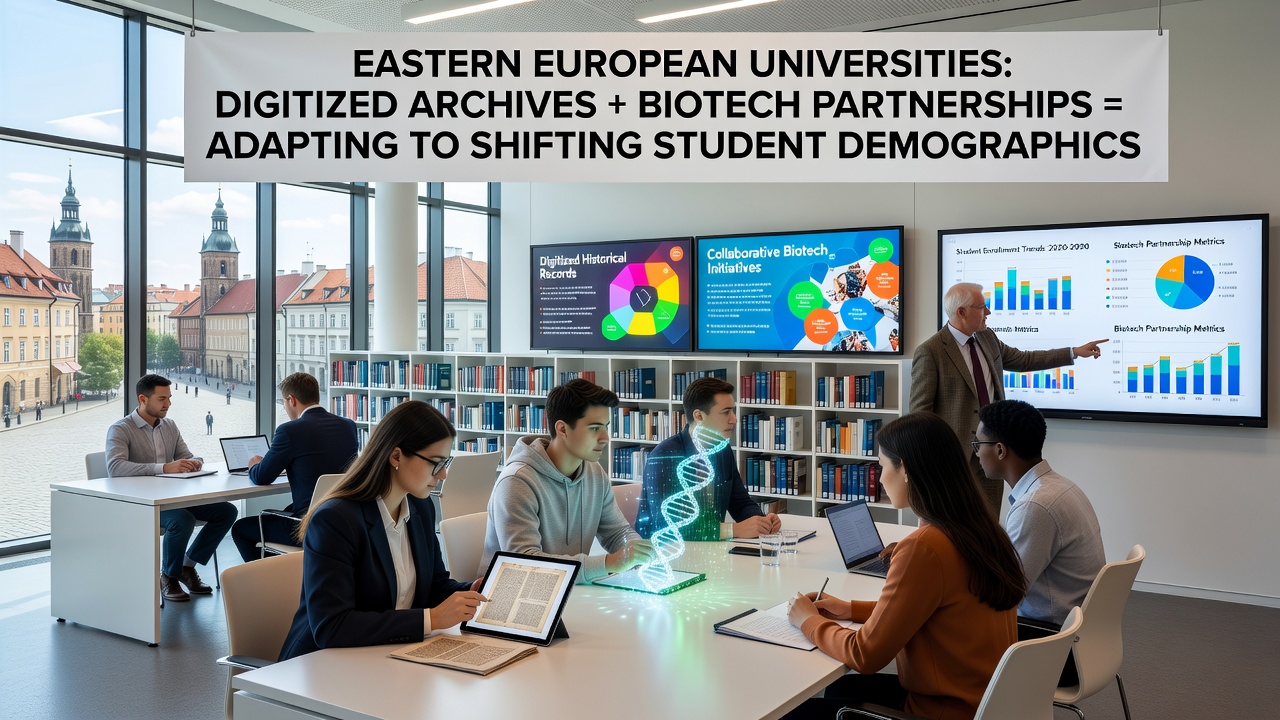
Universities across Poland, Hungary, and the Czech Republic have begun merging digitized historical collections with biotechnology industry ties, and these efforts coincide with measurable changes in student enrollment patterns driven by lower birth rates and increased mobility among applicants from outside the region. Data from the European Commission shows enrollment from domestic cohorts dropped by 12 percent between 2020 and 2025 while international applications rose by 18 percent in the same period, prompting institutions to develop programs that combine archival research tools with applied biotech training.
Demographic Pressures Reshape Enrollment Patterns
National statistics offices report that the 18-to-24 age group in several Eastern European countries contracted by nearly 15 percent over the past decade, and universities responded by expanding outreach to students from Asia and the Middle East. In September 2026 multiple rectors plan coordinated recruitment events in Seoul and Istanbul that highlight new joint degrees built on archived biological datasets and current gene-editing techniques. Observers note that institutions which digitize older medical and botanical records gain an edge when marketing to applicants who seek interdisciplinary credentials rather than single-discipline tracks.
Digitization Projects Create New Research Resources
Teams at Charles University in Prague and Jagiellonian University in Kraków completed large-scale scanning of 19th-century herbarium specimens and epidemiological ledgers between 2022 and 2025, converting more than 2.3 million pages into searchable formats. These collections now feed machine-learning models that identify plant compounds with potential pharmaceutical value, and the same datasets serve as teaching material in courses that attract applicants interested in computational biology. Funding for the digitization came from national research councils and supplementary grants issued through the European Research Area, allowing smaller departments to participate without diverting core operating budgets.
Biotech Industry Links Supply Applied Context
Companies such as Selvita in Poland and Gedeon Richter in Hungary established formal internship pipelines that place master's students inside laboratories working on antibody development and fermentation optimization. The agreements require universities to supply both fresh samples and curated historical data, creating a feedback loop in which archival material informs ongoing experiments. Figures released by the European Federation of Biotechnology indicate that Eastern European partner labs filed 47 joint patents involving digitized records in 2024, up from 19 filings three years earlier.

Program designers structured the new curricula so that students spend one semester annotating historical records and the next semester applying those annotations to live biotech protocols. Graduates receive dual certification recognized by both the academic senate and the partner company, a credential that appears on transcripts beginning with the 2026 intake. Enrollment offices report that inquiries for these tracks exceeded projections by 27 percent during the most recent application cycle.
Cross-Institutional Networks Extend Reach
Consortia formed under the Central European University Alliance coordinate shared digital repositories so that a student at the University of Szeged can query Prague herbarium images without separate access agreements. Network administrators completed the first full data-migration test in spring 2025, and uptime metrics exceeded 99.4 percent during the trial period. The same platform supports remote collaboration with industry scientists who contribute real-time experimental metadata, closing the loop between archived knowledge and contemporary laboratory practice.
Language-training modules embedded in the biotech tracks help non-native speakers navigate both technical terminology and the older Latin or German notations that appear in many digitized documents. Universities added these modules after feedback from the 2024 cohort showed that reading fluency in historical sources improved project completion rates by roughly one-fifth. Placement offices track outcomes through alumni surveys, and early returns indicate that participants secure industry positions at rates comparable to those from longer-established Western European programs.
Conclusion
Institutions continue to refine the integration of digitized archives and biotech partnerships as enrollment data for the 2026 academic year arrives. National ministries have scheduled joint reviews in late 2026 to assess whether the combined approach sustains applicant numbers and supports regional research output. The records already digitized and the agreements already signed provide a concrete base for those evaluations, while additional scanning projects and industry contracts remain under negotiation.